The McKinsey Ecosystem game: complete strategy guide
In this guide
Overview & objective
In the Ecosystem module you're given a pool of species: producers (plants / algae) and animals, and environmental data for each. Your job is to (1) pick a starting location and a set of producers, (2) build a matrix of species and predator–prey relationships, and (3) derive the longest viable food chain (up to 8 species) that maximizes total calories flowing through the chain.
Each species has:
- Calories provided, energy available to predators.
- Calories required, energy the species itself needs to survive (0 for producers).
- Depth/elevation range and temperature range, environmental constraints (producers only).
A predator can only eat a prey if it's listed as able to do so. The calories a prey provides minus the calories the predator requires gives the "net" energy available to the next level up.
Step 1: pick the optimal producers
Producers are grouped by their environmental range (depth/elevation + temperature). The optimal starting location is the environmental cell shared by the most producers that maximizes total calories provided. In practice: group producers with identical ranges, sum the calories in each group, and pick the group with the highest total.
Step 2: build the species matrix
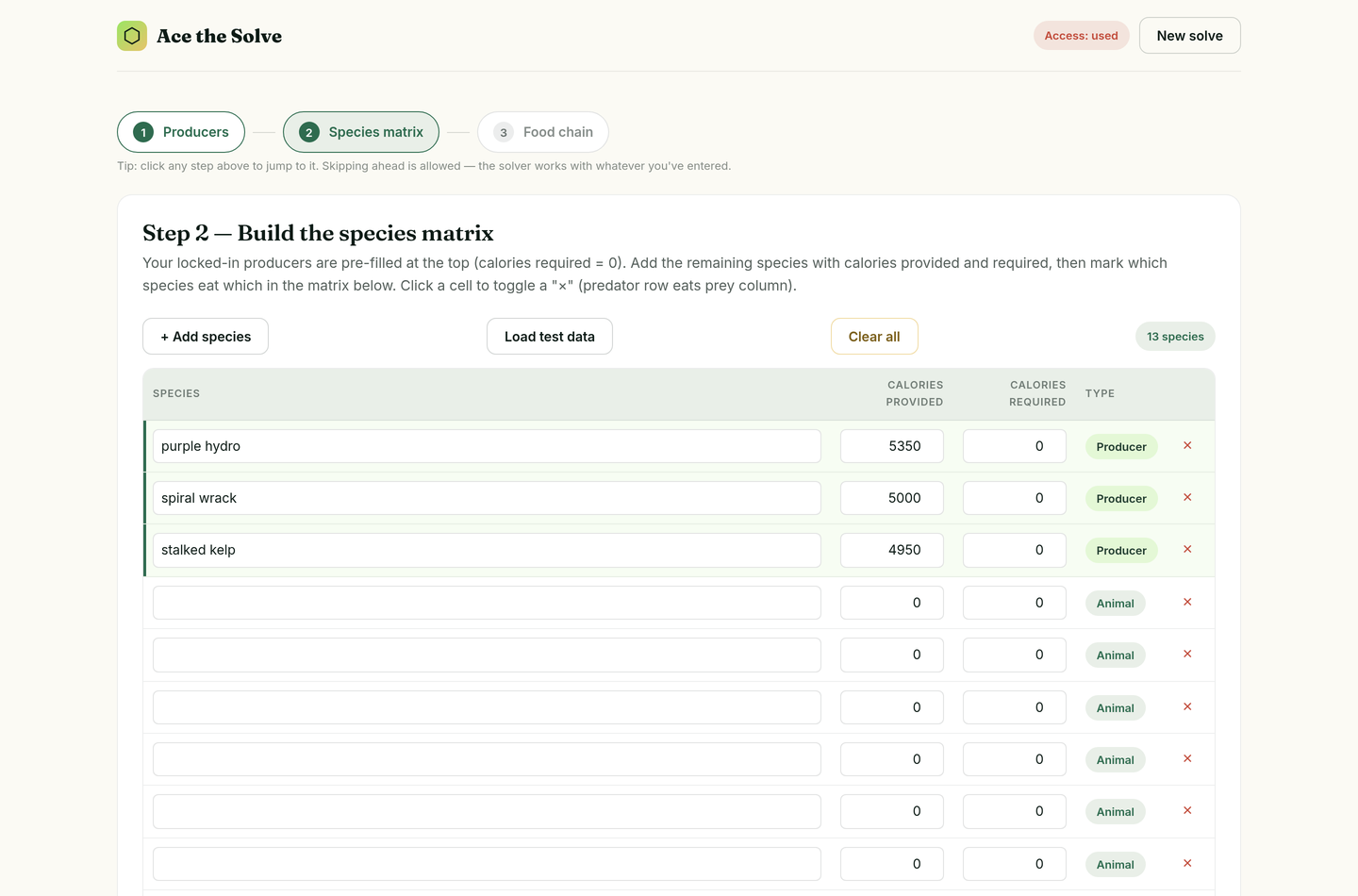
With producers locked in, you add the remaining animal species. Each animal has calories provided and calories required. You then mark which species eat which in a predator–prey matrix. A "×" in cell (row, column) means the row species eats the column species.
Constraints:
- No species eats itself.
- A predator must be able to get enough net calories from its prey to survive.
Step 3: derive the optimum food chain
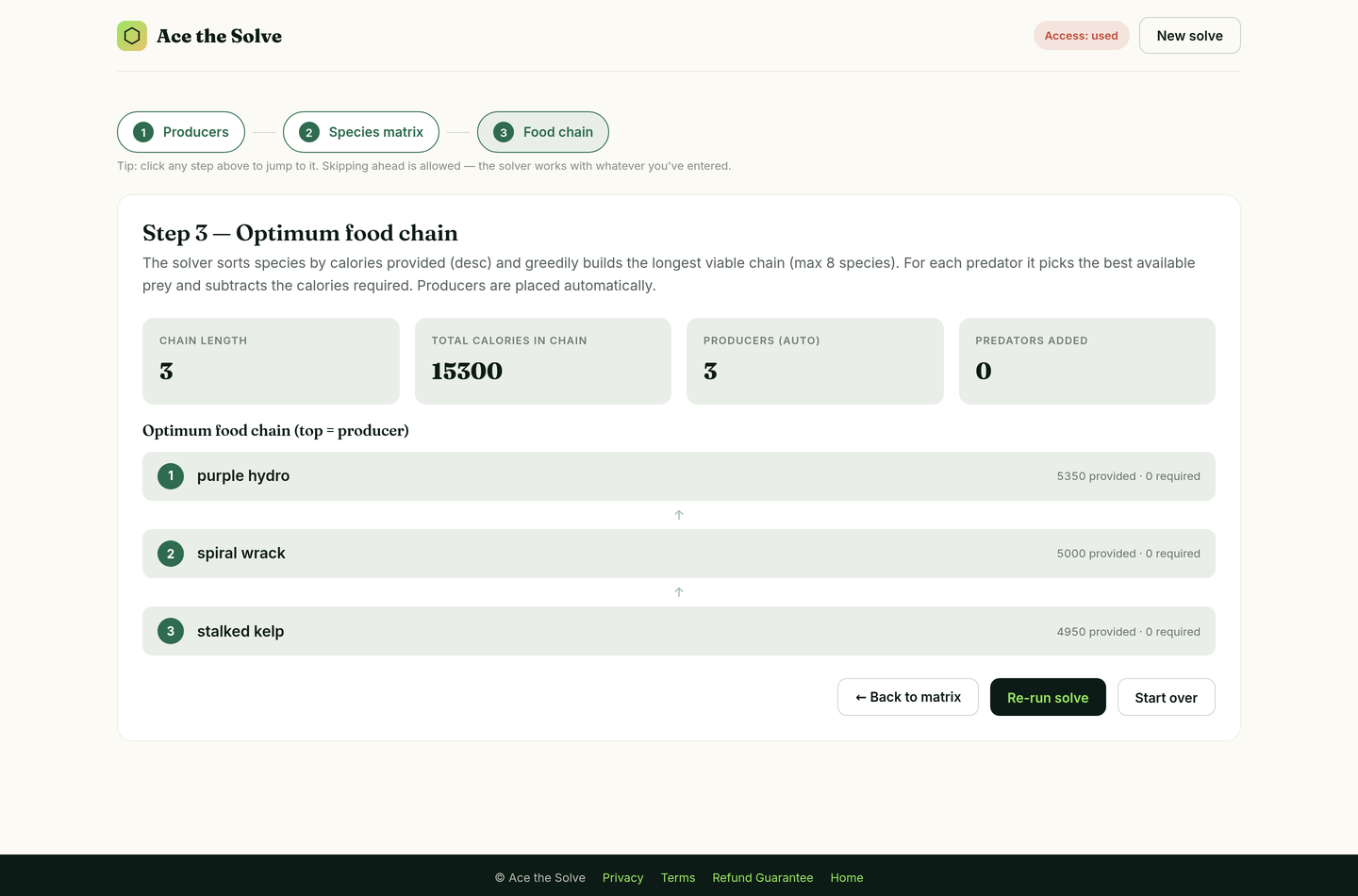
The optimum food chain is up to 8 species long, with producers at the base. The algorithm sorts species by calories provided (descending), greedily places producers, then for each predator selects the highest-calorie available prey whose remaining calories (after subtracting the predator's requirement) are still non-negative. If the best prey can't sustain the predator, it falls back to the next-best available prey.
How you're scored
- Chain length, longer is better (max 8).
- Total calories in the chain, higher is better.
- Producer set quality, did you pick the highest-calorie group?
- Move efficiency, how quickly you completed the steps.
Optimal strategy
- Always group producers by identical environment. Don't mix depth/temperature ranges, it dilutes your calorie total.
- Pick the group with the highest calorie sum, not the single highest-calorie producer.
- In the matrix, be comprehensive. Mark every true predator–prey relationship you can find, the algorithm can't use a relationship you didn't enter.
- Work fast. The selection algorithm itself is deterministic; the score-killer is time spent second-guessing.
- Balance accuracy and speed across modules. Ecosystem rewards calculation discipline; Sea Wolf rewards fast repeated decisions, which you can practise in the Sea Wolf Simulation, the Redrock Simulation and the Sustainable Futures Lab.
Sources (3)
- PrepLounge forum, "McKinsey - Solve Game" (2025): candidate and coach confirmation that Ecosystem Creation was phased out of Solve around mid-2025 and that current invitations pair Redrock Study with Sea Wolf. preplounge.com
- PrepLounge forum, "McKinsey Solve Game Preparation" (2025): coach and candidate confirmation that the Ecosystem game no longer appears in current invitations. preplounge.com
- Wall Street Oasis forum, McKinsey Solve threads: candidate accounts of the legacy Ecosystem game's scoring (calories, chain length, move efficiency) before its retirement. wallstreetoasis.com